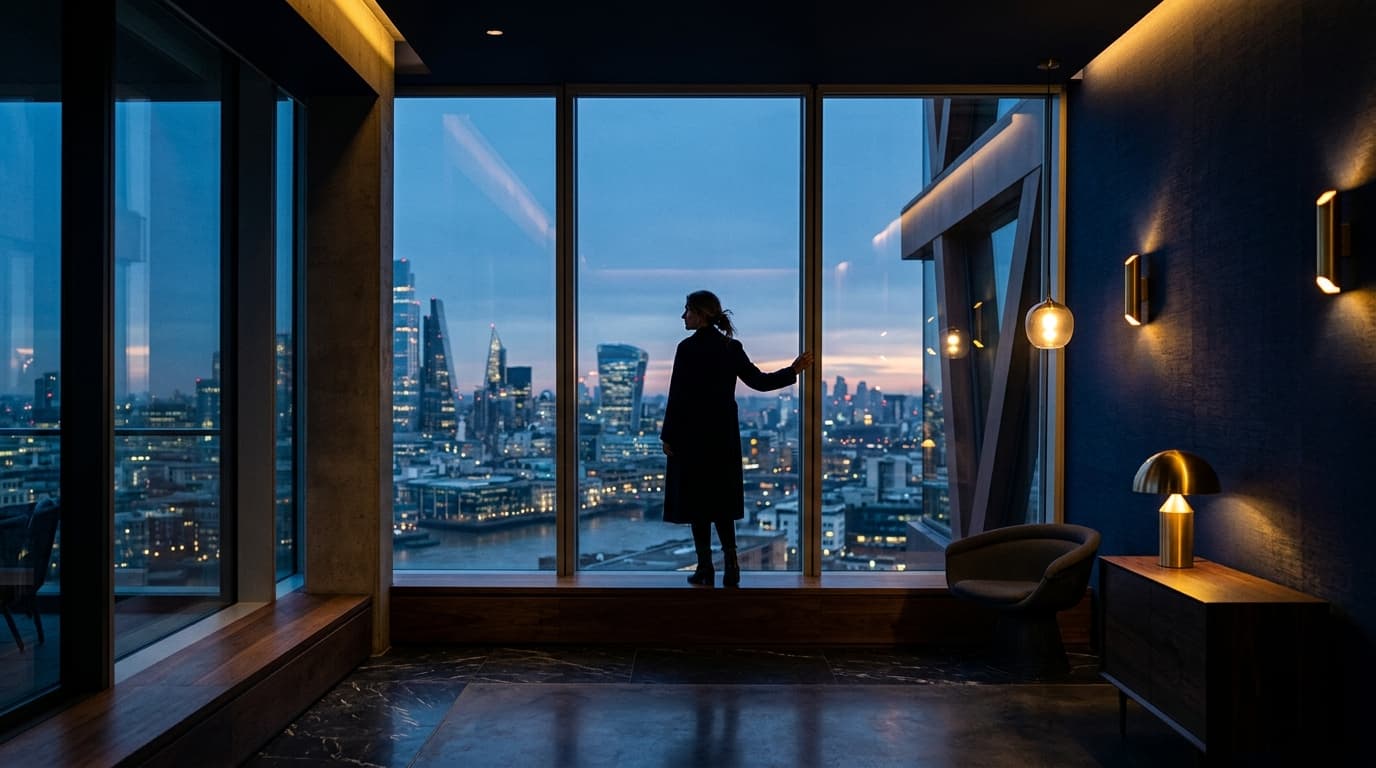
You left. You built a life somewhere else — London, Houston, Toronto, Dubai, Atlanta. You achieved things that once felt impossible from where you started. You carry yourself with a weight that commands attention in rooms you had to work to enter. And yet, something still feels incomplete.
It shows up quietly. In the apartment that never quite feels like yours. In the house back home that looks finished but feels hollow. In the office you designed meticulously but sit in restlessly. You have the space. You have the resources. And still, something is missing.
This is not a design problem. It is a self problem.
"You cannot design a space that reflects who you are if you have not yet decided who you are. The room will always feel borrowed until the self inside it is entirely yours."
— Zeki Ubor, Principal & Founder, Mindvest Global
The Diasporian Condition: You Built the Life. But Whose Life Is It?
Migration demands a particular kind of performance. You arrive in a new place and you adapt — sometimes brilliantly, sometimes desperately. You learn the codes: the way people dress, the way they speak, what they value, what they laugh at. You integrate. You succeed.
But integration has a shadow cost. In the process of becoming acceptable to a new environment, many diasporians quietly let go of the architecture of who they actually are. They build a version of themselves shaped entirely by external conditions — what the job required, what the culture expected, what survival demanded.
The result: you reach a level of material success and find that the person standing inside that success is a stranger. Not bad. Not broken. Just not entirely yours.
And the spaces you inhabit — back home or abroad — reflect this precisely. You have acquired taste, but you haven't designed an identity. You can articulate what looks good, but not what feels true. The gap between those two things is where most diasporian design projects quietly fail, not for lack of budget, but for lack of a defined self to design around.
Framework I: Identity & Purpose — The Foundation of Everything You Will Ever Build
At Mindvest Global, our Human Architecture Framework begins at the layer most people are most afraid to examine: Identity & Purpose — what we call the Foundation.
Before systems, before habits, before relationships, before the way you show up in the world — there is the question of who you actually are. Not the role you inhabit. Not the nationality on your passport. Not the version of yourself that emigration required you to become. The original.
Identity & Purpose
The Foundation — Who you are beneath what the world made you. This layer asks the questions most people defer until crisis forces them: What do I actually believe? What am I actually for? Who was I becoming before I started performing for approval?
In The Becoming Institute, this layer is not explored through journaling prompts or affirmations. It is interrogated with the same precision an architect applies to a structural audit — diagnosing what is load-bearing, what is cosmetic, and what has already quietly cracked.
For the diasporian specifically, this layer carries an additional weight: the tension between the identity you were given at home and the identity you constructed abroad. Both are real. Neither, on its own, is complete. The work of Framework I is to hold both threads — the roots and the reach — and weave them into something coherent, original, and yours.
This is not nostalgia. It is not a call to "go back." It is a call to integrate — to build a self that is genuinely at home everywhere, because it is no longer dependent on any environment to tell it who it is.
Then — and Only Then — You Design the Space
When a diasporian client brings a brief to Elevation Studio, one of the first things we listen for is not the aesthetic references or the Pinterest boards. We listen for the person behind the brief.
What is this space meant to declare? What version of this person should someone feel when they enter this room? Is this a space of arrival — finally landing somewhere that feels like home — or is it a space of aspiration, designed for the person they are still becoming?
The best spaces answer those questions clearly. They are not just well-furnished. They are architecturally honest — every material choice, every light temperature, every spatial proportion reflects a deliberate statement about who lives here and what they value.
Elevation Studio works with diasporian clients — many of them building homes and offices in Nigeria while managing the project from abroad — to bridge the gap between international design standards and local execution realities. Remote briefs. Digital walkthroughs. Material sourcing with transparency. Spatial design that does not compromise precision because of distance.
But the most successful projects — the ones that feel like they were exhaled rather than just completed — begin with a client who has done the inner work first. Who knows what they are designing towards. Who can articulate not just what they want the room to look like, but what they want the room to feel like to be.
"The most beautifully designed spaces are the ones where you can feel the person who lives there — their certainty, their values, their particular way of being in the world. That certainty is not a design choice. It is an identity choice made first."
The Invitation: Design Yourself First
If you are a diasporian reading this — wherever you are in the world — and something here has landed, I want to offer you a clear sequence:
- Begin with the Foundation. Before the renovation, before the new build, before the interior brief — sit with the question of identity. Who are you beneath the version of yourself that emigration required? The Becoming Institute's personal evolution work begins exactly here, with an Architecture Audit that maps what is load-bearing in you and what has quietly been hollow.
- Design from that clarity. When you know who you are — not as a performance, but as an architecture — the spatial brief writes itself. You stop chasing references and start making declarations. Every room becomes a sentence in a story you are consciously authoring.
- Let Elevation Studio execute with that precision. Whether you are building in Lagos, Abuja, or beyond — bring a brief that is rooted in self, and we will design a space that speaks that language with architectural fluency.
These are not two separate conversations. They are one. The self and the space are in constant dialogue. The question is only whether you are designing that dialogue deliberately or leaving it to chance.
You left home to build something. Come back — or wherever you build — with the architecture of yourself as your primary blueprint. Everything else will follow with a clarity that no amount of money, taste, or square footage can buy on its own.
— Zeki Ubor
Principal & Founder · Mindvest Global